
I make complex systems legible enough to trust.
I design the path through data-dense systems: what people need to understand first, what evidence they need beside them to take action, where judgment needs to remain in the user's hands, and what user data the team needs in order to build something even better after the first version ships.
13+ years of turning messy work into usable systems.
The throughline
Spent more than a decade making complex work easier to understand, trust, and act on — from climate data and supplier workflows to AI guidance, public infrastructure data, and human-legible products.
Climate-tech product work
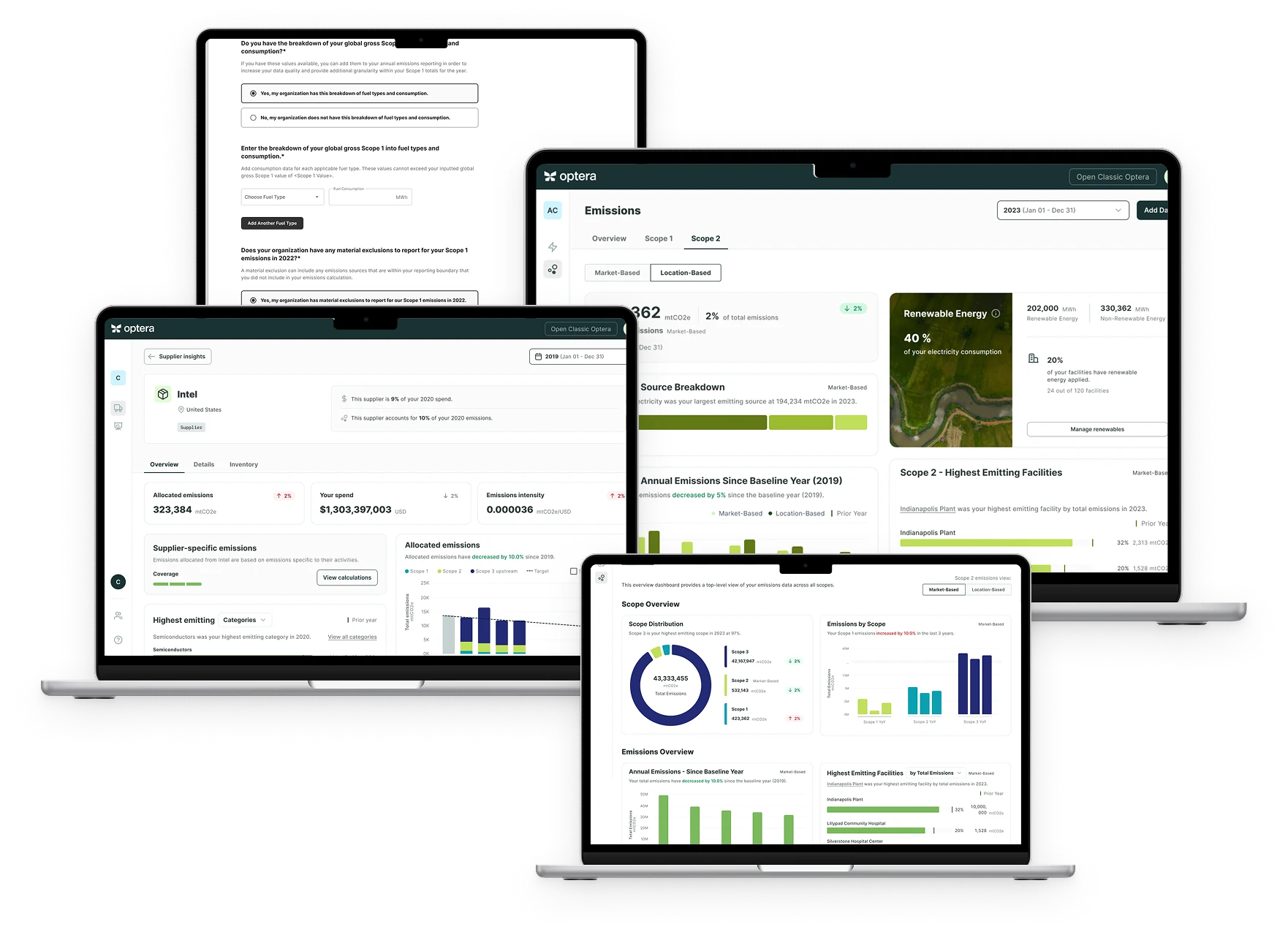
Led product design at Optera through April 2026, mapping emissions, supplier, intake, review, and reporting journeys into reusable product systems.
Now
Designing with AI as both material and user: people need clarity, and agents need structured context, permissions, evidence, and reviewable actions.
What changed
Research, product language, prototypes, evals, documentation, and handoff now sit closer together, with sources and judgment kept visible.
What didn't change
Talking to users, following the full journey, reducing decision friction, and knowing when a pause, label, review gate, caveat, or small moment of explanation changes the whole experience. The tools got faster. The judgment still has to land.
Selected artifacts.
Optera
Climate-tech product design2021 — Apr 2026
Five years turning emissions, supplier, intake, and review journeys into scalable product systems — including a feedback intake system that reached company-wide adoption in 30 days.
Helm
Execution intelligence2026 — Present
Execution intelligence redesigned around intent, evidence, drift, review, and action, after auditing every user story across three personas before proposing a screen.
GridPath
Public-data prototype2026
Paired with Quiet Hours: public-source grid intelligence that makes infrastructure, weather, outage, emissions, queue, and community signals spatial and inspectable.
Quiet Hours
Energy timing2026
Paired with GridPath: a location-aware energy story that translates grid signals into calmer household guidance and source-aware recommendations.
Between Nowhere
Mobile human-legible2026
Two-day human-legible build that turns the FCC Amateur Radio Technician question pool into guest-friendly entry, animated concepts, paced practice, and review for confidence.
FieldRules
AI governance product experiment2026
AI governance experiment testing whether domain expert reasoning changes model behavior: 36 scenarios, 10 healthtech domains, reasoning fields, evals, and source-backed archives.
The system around the work.
The stack matters when it keeps research, product language, evidence, prototype behavior, and handoff close enough that judgment survives the sprint. I design the product and the operating system around it.
- GPT Deep Research
- User research sessions
- Observed User Behavior
- User Journey Mapping
- Lovable
- Codex
- Claude Code
- GitHub
- Notion Index & Repository
- Obsidian
- claude-mem
- Design Systems
- Design Token .md files
- Workspace skills and automations
- Lovable
- Figma Make
- Figma MCP
- Figma Design
How I turn complexity into confident next steps.
I start with the user's mental model, not the org chart or the feature list. Then I design the path, evidence, language, states, and review moments that make the next responsible action clear.
- 01
Map the end-to-end user journey
Talk to users, follow the work across handoffs, and understand what people are trying to decide, avoid, trust, or recover from.
- 02
Find the highest-friction decision points
Name the moments where the user has too little clarity, too much risk, or too many paths that look almost the same.
- 03
Design the product behavior around those moments
Use flows, language, states, prototypes, and real data to make the next step easier to understand, choose, and trust.
- 04
Test the design against reality
Validate with users, edge cases, data checks, critique, and quality gates so the design survives contact with real use.
- 05
Turn the decision point into a reusable pattern
Capture sources, decisions, user language, design rationale, and rules so the team does not keep rediscovering the same answer.
- 06
Make the surrounding system easier to run
Add the routines, skills, review gates, and shared standards that help design, product, and engineering move with less drag.
Built teams. Shipped systems. Taught patterns.
VP / Director-level design leadership
Built and mentored design teams across stages
Built design systems and shared quality standards
Led workshops and cross-functional alignment
Translated technical complexity for non-technical teams
Shipped practical, principled AI adoption guardrails
The pattern people name after working with me.
“product designer and a product thinker in the same person”
Michael Koenig
Managed Melanie directly
“one of the most creative and collaborative leaders”
Jenny Jones
Cross-functional partner
“benchmark for excellence that I still reference”
Hilary Rallo
UX engineering partner
“champion for introducing AI into our workflow, across multiple teams”
Gautami Chennur
Direct report
“one of the most exceptional design leaders I’ve ever collaborated with”
Ty Colman
Executive partner
“fierce advocate for her team”
Katie Oakes
Leadership teammate
How I think about the next era of design.
Journey Mapping Is Still Human Work
AI can summarize research conversations, generate flows, and produce tidy diagrams. The harder design work still happens in the listening: what does not fit, where the decision actually gets hard, and how the product enters the user's real world.
Read essayWays of workingChaos Pretending to Be Speed
Fast work can be useful. Frantic work just makes ambiguity louder. Four months of building taught me that real speed depends less on motion and more on judgment, structure, and knowing what standard the work has to meet.
Read essayAI-assisted workCoherence Is the Bottleneck
AI-assisted work makes generation faster. Product judgment matters more, because coherence, maintenance, and aligned decisions get harder to fake.
Read essayProduct handoffThe handoff is the interface around the prototype
A prototype URL gets someone into the work, but it leaves too much for them to decode: what they are looking at, how it relates to their world, what parts are real, and what kind of feedback would actually help.
Read essayProduct languageVocabulary is product strategy
Words are load-bearing walls. When a team changes a word, it changes the product it is building.
Read essayAI-assisted designHeadless does not mean designless
When a platform is mostly consumed by agents, design moves into contracts, defaults, permissions, feedback loops, tool descriptions, source health, and the parts of the product humans may never directly touch.
Read essayProduct developmentThe SDLC is changing under our feet
When designers can shape schemas, prototype against real data, and ship production-level features, the path to MVP starts to feel less like a relay race and more like a tighter loop of judgment, evidence, and build.
Read essayPoint of viewDesign is moving closer to the work
AI-assisted design gives designers a shorter path between judgment, evidence, implementation, and the product itself.
Read essayOperating modelTeams need one place decisions stay findable
Teams win when their tools can work from the same current understanding.
Read essayAI-assisted practiceDisciplined Ideation in the Age of AI
Useful AI-assisted product improvement pressure-tests ideas against UX heuristics, behavioral science, HCI research, product evidence, and the realities of machine learning.
Read essay